
Choosing a performance marketing agency is one of the highest-stakes decisions a home ecommerce founder makes. Get it right and your store breaks through to a new revenue level. Get it wrong and you are out tens of thousands in wasted budget, three months behind, and back to running ads yourself.
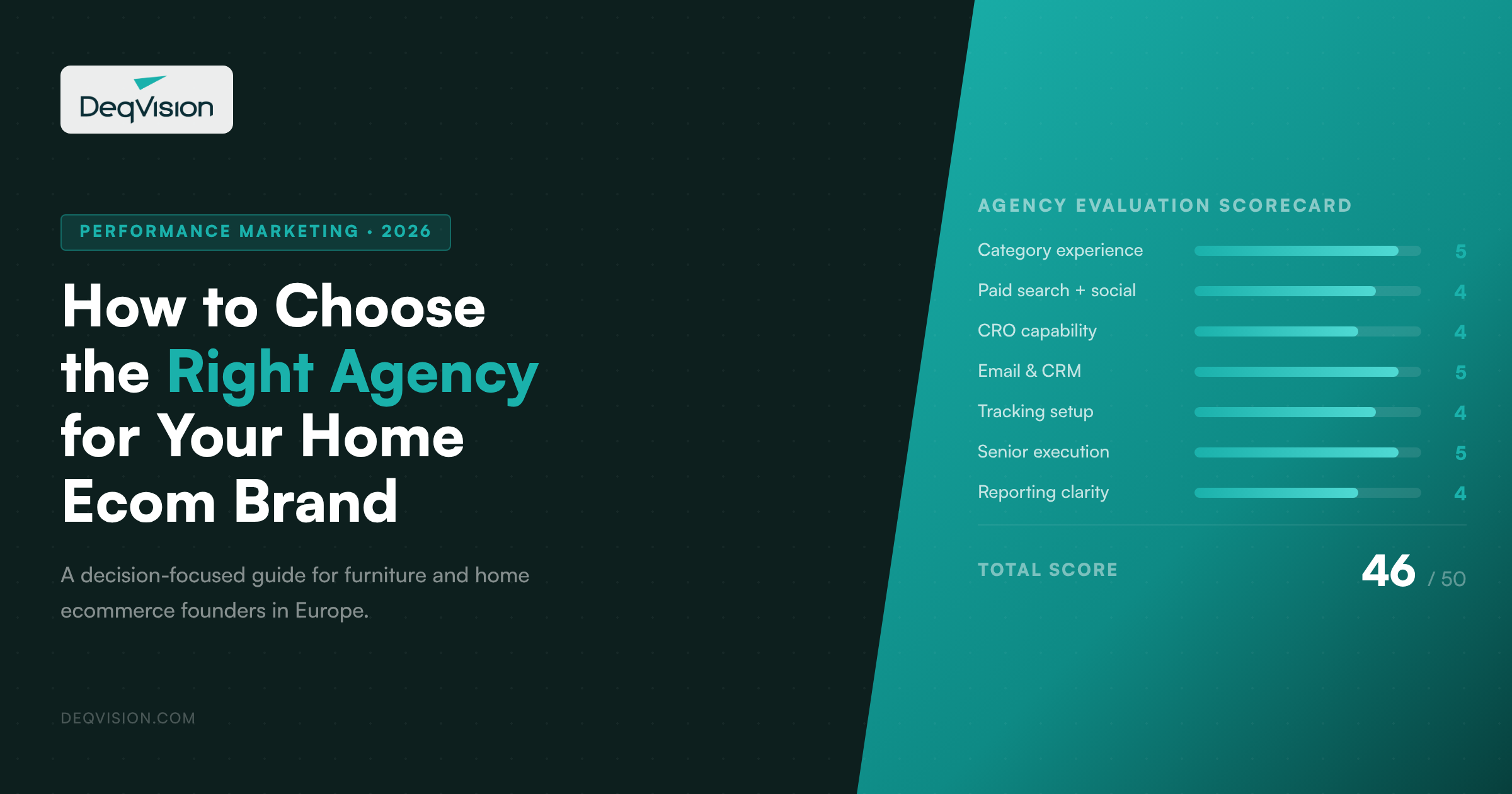
This guide gives you a clear framework for evaluating your options in 2026. What services actually matter, what questions to ask, what red flags to walk away from, and a scorecard you can use to compare agencies side by side. It is written specifically for furniture and home goods ecommerce brands in Europe, because this category has unique dynamics that most generic agencies do not understand.
What Is a Performance Marketing Agency for Furniture and Home Ecommerce?
A performance marketing agency is a partner that manages your paid acquisition channels, covering paid search, paid social, and email, with a focus on measurable revenue outcomes rather than vanity metrics like impressions or reach.
For furniture and home ecommerce, this definition matters more than in most categories. Your products have:
- High average order values: typically €80 to €2,500
- Long consideration cycles: buyers research for days or weeks before purchasing
- Trust-dependent buying behaviour: customers need confidence before committing to a big purchase
- Lifestyle-driven decisions: they are not just buying a sofa, they are buying a version of their home
A generic performance marketing agency will treat your €800 sofa the same way it treats a €20 phone case. Same short attribution windows. Same single-touch ad structure. Same 30-day result promises. That approach will fail here, and it is the reason most home ecom founders have burned through two or three agencies before finding the right fit.
The right performance marketing agency for a furniture or home goods brand understands the full-funnel architecture required for high-AOV, long-consideration products. It builds campaigns accordingly.
The 4 Core Services to Evaluate
When assessing any agency, focus your evaluation on four service areas. These are the levers that drive revenue for home ecommerce brands.
1. Paid Search and Social Advertising
This is the engine of your acquisition. For home ecom brands in Europe, this means:
- Meta Ads (Facebook and Instagram): Essential for awareness, retargeting, and lifestyle-driven creative. The agency should run separate campaigns for cold audiences, warm retargeting, and past purchasers, not one campaign doing everything.
- Google Ads (Shopping and Search): Home buyers actively search for products. If you are not capturing that intent with Shopping campaigns and branded search, you are handing revenue to competitors. Many home ecom stores skip Google entirely or run it badly. This is a consistent gap an agency should fix.
- TikTok and Pinterest: Increasingly relevant for home decor and lifestyle brands. A forward-thinking agency should have a clear view on where these channels fit at your budget level.
What to evaluate: Ask the agency how they structure campaigns specifically for high-AOV products. What does their full-funnel architecture look like? What attribution windows do they use, and why?
2. Conversion Rate Optimisation (CRO)
Driving traffic to a website that does not convert is expensive. CRO is the discipline of improving the percentage of visitors who complete a purchase. For home ecommerce, this includes:
- Product page trust signals (reviews, delivery clarity, return policy)
- Lifestyle imagery that matches buyer aspiration
- Page speed. A 1-second improvement can lift conversion rate by 2 to 7%
- Mobile experience. Over 60% of home ecom traffic comes from mobile
- Checkout flow friction reduction
CRO is often the fastest revenue lever. If your store converts at 1.5% and a CRO intervention brings it to 2.5%, your paid media spend immediately becomes more efficient without spending an extra euro on ads.
What to evaluate: Ask for an example CRO audit they have conducted for a similar brand. What were the findings? What did they change? What was the measurable impact?
3. Email Marketing and CRM
Email is the highest-ROI channel in ecommerce and the most consistently underused by home goods brands. If your email list has 2,000 or more contacts, you have a revenue asset that is not being activated. The non-negotiable flows for home ecommerce:
- Welcome series: sets expectations, builds trust, converts new subscribers
- Abandoned cart: recovers buyers who were close
- Browse abandonment: re-engages visitors who showed product interest
- Post-purchase: drives repeat purchases and referrals
- Win-back campaigns: reactivates dormant customers
A brand generating €50,000 per month from paid ads alone should be generating an additional €10,000 to €20,000 per month from email. If that is not happening, email is a significant untapped channel.
What to evaluate: Ask the agency to walk you through a specific email flow they have built for a home or furniture brand. What was the revenue contribution from email before and after their involvement?
4. Tracking and Attribution
This is the least visible service area and the one most often done badly. If you cannot accurately measure what is driving revenue, every decision you make about budget allocation is a guess. In 2026, tracking has become more complex due to iOS privacy changes, browser tracking restrictions, and platform-level attribution discrepancies. A strong agency should have:
- Server-side tracking or Conversion API implementation (Meta CAPI, Google Enhanced Conversions)
- A clear attribution model that accounts for the long consideration window in home ecommerce
- Centralised reporting across channels, not just platform-native dashboards, which over-claim credit
- Regular data hygiene checks
What to evaluate: Ask how they handle attribution for products with a 14 to 30-day consideration window. Ask what tracking infrastructure they set up on day one. If they cannot answer this clearly, your data will be unreliable from the start.
5 Questions to Ask Every Agency Before Signing
These questions are designed to separate experienced home ecommerce agencies from generalists who will apply the wrong playbook to your business.
1. How do you structure campaigns for products with AOV above €300?
The answer should reference full-funnel architecture, separate awareness and retargeting campaigns, and longer attribution windows. A generic answer about "testing creatives" is a warning sign.
2. Can you show a case study from a furniture or home goods brand with before-and-after revenue numbers?
Anyone can claim results. Verified case studies with specific numbers are what builds justified confidence. Ask for the brand name and the timeframe.
3. How do you set realistic expectations for the first 90 days?
Home ecom has a 14 to 30-day buyer consideration cycle. Any agency promising significant results in 30 days either does not understand the category or is over-promising to close the deal.
4. Who will actually be working on my account?
Many agencies win business at the senior level and hand execution to junior staff. Ask specifically who manages the day-to-day work, what their experience level is, and whether you will have direct access to them.
5. What does your reporting look like and how do you measure success?
The answer should focus on revenue, ROAS, customer acquisition cost (CAC), and lifetime value (LTV), not clicks, impressions, or reach. If the first metrics they mention are vanity metrics, take note.
Red Flags to Walk Away From
These are common signals that an agency is not the right fit for a home ecommerce brand:
- They guarantee results in 30 days. High-AOV home products have long consideration cycles. Anyone promising specific revenue results in 30 days does not understand the category.
- They cannot name a furniture or home goods client when asked. Home ecommerce is a specific category. An agency with no experience in it is learning on your budget.
- Their reporting is built around impressions, reach, and clicks. These metrics do not pay your suppliers. If an agency leads with vanity metrics, they are optimising for the wrong things.
- They pitch a single channel as the solution. A Meta-only or Google-only agency will deliver a partial result at best. Revenue growth in home ecommerce requires coordinated multi-channel execution.
- They have a high junior-to-senior ratio on delivery. The strategy you are sold by a senior account director should be the strategy executed on your account. Ask who does the actual work.
- They want a 12-month lock-in before you have seen any results. A confident, competent agency does not need to trap clients. Performance should earn the relationship.
What Good Performance Marketing Actually Looks Like for Home Ecommerce
To give this framework context, here is what the right agency delivers in practice.
Multimebeli, a furniture ecommerce brand, had been running Meta ads with inconsistent results before switching to a full-funnel, home-ecom-specific approach. Within 12 months: 14x consistent ROAS, 57% revenue increase, and 416 new customers acquired. The difference was not a bigger budget. It was an agency that understood how furniture buyers actually make decisions.
Pavirani, a home ecom brand in the scaling phase, needed a team that could run Meta and Google as a unified system while activating their email list. The result: 7x ROAS and a 42% increase in average order value. The AOV uplift came from CRO work on product pages, a channel most performance agencies do not touch.
In both cases, the breakthrough came from three things working together: the right paid media architecture for high-AOV products, CRO improvements to the website, and email flows that turned first-time buyers into repeat customers. That is what a genuine performance marketing agency for furniture and home ecommerce delivers. Not traffic. Revenue.
Summary: The 5 Things That Separate the Right Agency from the Wrong One
- They have real experience in the home ecom category, not just ecommerce in general
- They run paid search and social as a connected system, not two separate channels with separate teams
- They treat CRO and email as revenue channels, not optional add-ons
- They set up tracking correctly from day one, so every decision is based on real data
- Senior people do the work, not junior staff executing a template handed down from above
The agency you choose should be able to demonstrate all five with specific examples. If they cannot, the risk of wasting another six months and a significant portion of your budget is real.
Ready to Scale Your Home Ecommerce Store?
At DeqVision, we work exclusively with home ecommerce brands targeting €150,000 per month and beyond. Our full-stack approach covers paid ads (Meta and Google), email marketing, CRO, and creative strategy, built specifically for the high-AOV, long-consideration buying cycle that defines this category.
We are founder-led, which means the people who sell you the strategy are the people who build and run it.
If you are a furniture or home goods brand in Europe currently at €30,000 to €120,000 per month and ready to scale, we would like to talk.