
Home Decor Ecommerce Agency: How to Scale High-AOV Home Decor Brands with Paid Media
Home decor ecommerce is one of the most misunderstood categories in digital marketing. Products are high-value, visually driven, and bought after a long consideration period. Most generalist agencies apply frameworks built for fast fashion or consumer electronics and wonder why results are inconsistent. A specialist home decor ecommerce agency builds systems designed specifically for how home decor buyers actually behave.
1. Why Home Decor Ecommerce Requires a Different Approach
The average home decor buyer does not make a decision on the first visit. They browse, save, return, compare, and consider for days or weeks before committing. This is a fundamentally different purchase journey from most ecommerce categories and it demands a fundamentally different marketing structure.
Home decor brands typically have:
- Higher average order values, often between €150 and €600 per transaction
- Visual-led discovery on Instagram, Pinterest, and Google Shopping
- Strong brand differentiation based on style, materials, and room context
- A multi-session buying journey spanning 7 to 30 days
- Seasonal peaks tied to interior trends, home renovation cycles, and gifting
Agencies that run a single sales campaign targeting cold audiences and measure results over 7 days will consistently underestimate performance and underspend on the channels that actually close the sale.
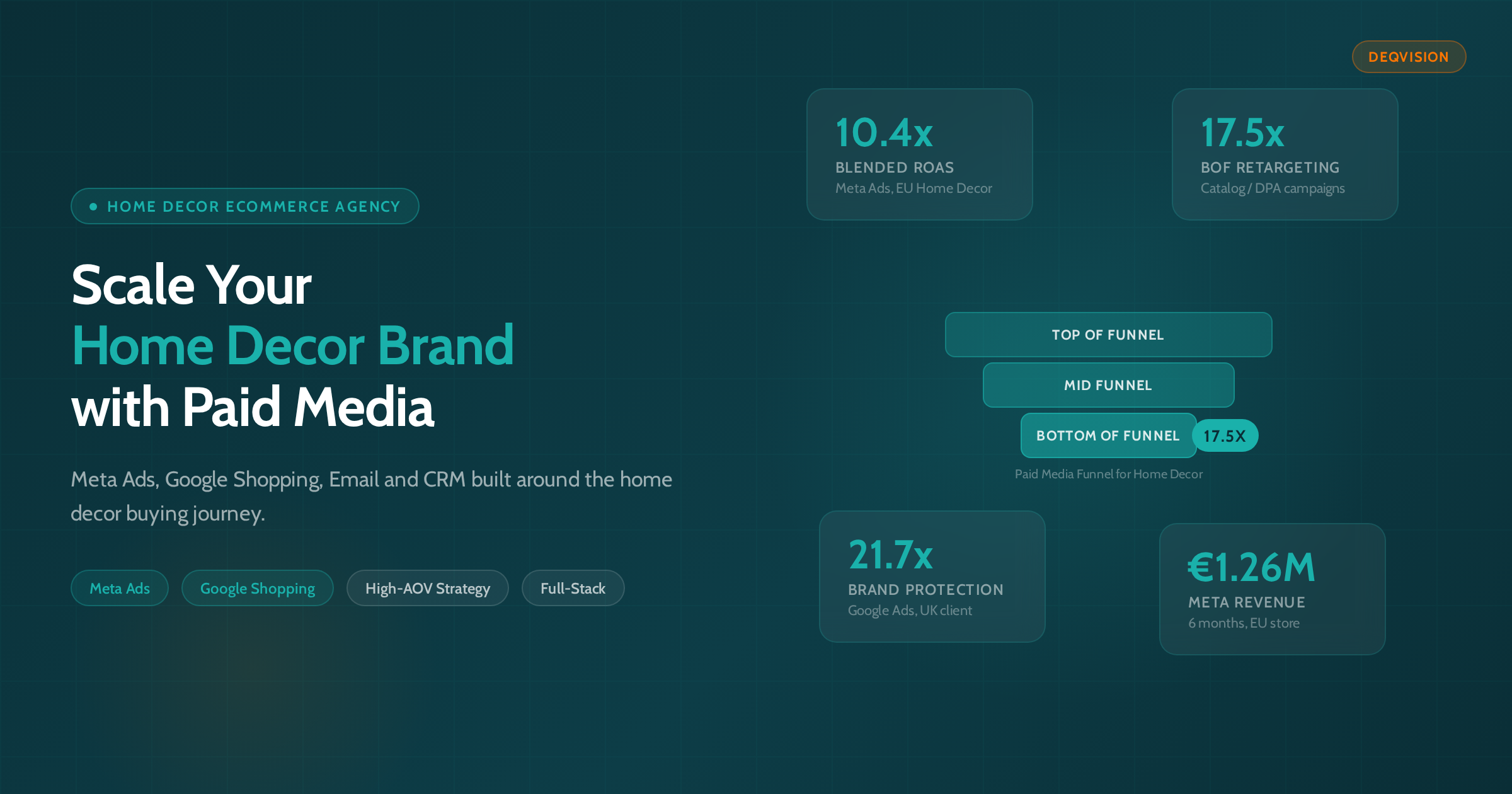
A European home decor store managed by DeqVision generated €1.26M in Meta Ads revenue over 6 months from €120,900 in spend, achieving a 10.39x blended ROAS and an average order value of €330. This was built on a structured three-layer funnel, not a single campaign.
2. The Three-Layer Paid Media Funnel for Home Decor
The most effective home decor ecommerce agencies build a paid media system with three distinct layers, each serving a different stage of the buyer journey and measured on different timeframes.
Top of Funnel: Awareness and Discovery
Top-of-funnel campaigns for home decor are not designed to generate immediate purchases. They plant the seed. Lifestyle video, room styling content, and broad prospecting audiences are used to introduce the brand to buyers who are in an early browsing or inspiration phase. ROAS at this stage is often below 1x, which is intentional. This spend feeds the higher-converting layers below it.
From our experience: in a European home decor account, the TOF video campaign ran at 0.96x ROAS. Left on its own, this looks like waste. In context, it generated over 436,000 product views and fed the retargeting layer that returned 14x to 17.5x ROAS. Top-of-funnel spend is the cost of filling your pipeline.
Middle of Funnel: Consideration and Retargeting
Once a buyer has visited product pages or engaged with content, they enter the consideration phase. Catalog ads (DPA), collection retargeting, and video view audiences are used to stay visible while the decision is being made. These campaigns need enough frequency to remain top of mind without becoming intrusive.
Bottom of Funnel: Conversion and Recovery
The bottom of the funnel targets buyers who have already signalled strong intent: add-to-cart, initiate-checkout, and recent product viewers. These audiences are small, cheap to reach, and convert at dramatically higher rates.
These figures are from a European home decor account managed by DeqVision from December 2025 to May 2026. The top-performing bottom-of-funnel campaigns operated at 14x to 17.5x ROAS while the blended account average was 10.4x. The gap between them is explained by the TOF investment that filled the upper funnel.
3. Meta Ads for Home Decor: What Actually Works
Meta Ads (Facebook and Instagram) are the primary discovery and consideration channel for most home decor brands. The platform's visual format suits the category and the targeting options allow precise reach against lifestyle, home improvement, and interior design audiences.
The most effective Meta Ads strategies for home decor ecommerce include:
- Lifestyle creative over product-only imagery. Buyers need to see the product in a room context, not on a white background. Ads showing styled interiors, real customer spaces, and room inspiration consistently outperform studio product shots.
- Catalog ads for retargeting. Dynamic Product Ads (DPA) automatically show the exact products a visitor viewed, at the right moment in the consideration window. In practice, these are among the highest-ROAS placements in any home decor account.
- Separate prospecting and retargeting campaigns. Running both in the same campaign causes the algorithm to optimise for the cheapest conversion, which is almost always a retargeting audience that would have converted anyway. Separating them protects prospecting spend and gives you accurate data on both layers.
- Longer attribution windows. A 28-day click window is essential for home decor. Using 7-day default attribution consistently undercounts conversions and leads to under-investment in campaigns that are actually working.
In the same European home decor account, the Catalog / DPA retargeting campaign returned 17.46x ROAS on €2,104 in spend over 6 months, generating €36,743 in revenue from 109 purchases. This is one of the most cost-efficient placements available to any home decor brand actively running Meta Ads.
4. Google Ads for Home Decor: Capturing Intent at the Right Moment
While Meta Ads create demand, Google Ads captures it. A buyer who has been exposed to your brand through Instagram and is now actively searching for "modern oak sideboard UK" or "home decor lighting online" is at a very different stage of the journey. Google Shopping and Search campaigns intercept this intent before a competitor does.
Shopping Campaigns
Google Shopping is essential for home decor ecommerce. Product titles, images, and pricing appear directly in search results, and buyers with high purchase intent can move from search to checkout in a single session. Feed quality is the single biggest determinant of Shopping performance: accurate titles, lifestyle thumbnails where permitted, correct categorisation, and competitive pricing signals all affect how often and for which queries your products appear.
Brand Protection
Once you are running awareness campaigns on Meta, competitors can and do bid on your brand name in Google Search. A branded search campaign costs a fraction of non-brand search and consistently returns the highest ROAS in any account.
In a UK furniture and home brand account managed by DeqVision, the brand protection campaign returned 21.68x ROAS, the highest of any campaign in the account. Total account performance over 6 months was £1.77M in revenue from £452K in spend at 3.92x blended ROAS, with an average order value of £860. Brand protection was the single most efficient line in the account.
Performance Max for Home Decor
Performance Max campaigns can scale volume for home decor accounts that already have strong conversion data and a well-organised product feed. They work best when layered on top of existing Shopping campaigns rather than replacing them. Without a baseline of conversion history, PMax tends to optimise toward low-value traffic.
5. Creative Strategy for High-AOV Home Decor Products
Creative is the most important variable in home decor paid media performance. Products between €150 and €600 are not impulse purchases. The creative has to do significant work: build desire, establish quality, create room context, and reduce purchase risk, all before the buyer reaches the product page.
Room Context
Show the product styled in a real or aspirational room. Buyers need to imagine the item in their home. White-background shots perform poorly for home decor at this price point.
Material and Detail
Close-up shots of texture, finish, and craftsmanship build the quality signal that justifies a higher price point and reduces post-purchase anxiety.
Social Proof in Creative
Customer photos, testimonials, and review overlays integrated directly into ad creative outperform brand-only imagery, especially for retargeting audiences.
Risk Reduction
Delivery guarantees, return policies, and payment flexibility mentioned in the ad copy reduce the perceived risk of a high-value online purchase.
6. How Meta, Google, and Email Work Together for Home Decor
The most effective home decor ecommerce agencies do not run Meta Ads and Google Ads as separate budgets with separate strategies. They build a single acquisition system where each channel plays a defined role.
| Channel | Primary Role | When It Works Best | Key Metric |
|---|---|---|---|
| Meta Ads (TOF) | Brand discovery and inspiration | Ongoing, feeds all other channels | CPM, reach, video views |
| Meta Ads (BOF) | Retargeting and conversion | 28-day window after site visit | ROAS, cost per purchase |
| Google Shopping | Intent capture | When buyer is actively searching | ROAS, conversion rate |
| Google Brand Search | Brand protection | Always on once Meta is running | ROAS, impression share |
| Email (Abandoned Cart) | Recovery for long-cycle buyers | Within 14 days of abandonment | Recovery rate, revenue |
| Email (Win-back) | Repeat purchase activation | 90+ days post-purchase | Revenue per send |
For home decor brands in the £30K to £150K per month revenue range, this integrated approach is what separates stores that scale from those that plateau. Each channel feeds the next. Meta creates the awareness that makes Google searches happen. Email recovers the revenue that paid acquisition generates but does not immediately close.
7. What a Home Decor Ecommerce Agency Should Actually Do
If you are evaluating a home decor ecommerce agency, the most important questions are not about which platforms they use but how they think about your buying cycle, your creative, and your data.
A specialist home decor ecommerce agency should be able to:
- Explain the difference between a 7-day and 28-day attribution window and why it matters for home decor specifically
- Structure campaigns across the full funnel rather than running a single sales objective at cold audiences
- Brief and evaluate creative based on lifestyle performance, not just CTR
- Set realistic ROAS expectations by funnel stage, not just blended account averages
- Integrate Google Shopping, Meta, and email as a connected system rather than separate channel efforts
- Show you what the account structure looks like and why each campaign exists
From our experience across home decor accounts: the most common mistake we see from brands joining DeqVision after working with a previous agency is a single campaign structure with no funnel separation. All spend is pointed at cold audiences with a purchase objective, and the account shows low ROAS because there is no retargeting layer to capture the buyers who visited but did not convert on the first session.
The VISIONARY Method for Home Decor Ecommerce
DeqVision is a full-stack digital marketing agency that works exclusively with home ecommerce brands in the UK and Europe. The VISIONARY Method is the structured growth framework applied across every home decor client account, covering:
- Strategy funnel architecture, channel selection, and 90-day milestone planning
- Web product page conversion, mobile experience, and site speed
- Ads Meta and Google campaign structure, creative briefing, and bid strategy
- Email welcome flows, abandoned cart sequences, and win-back campaigns
- CRM customer segmentation, lifecycle marketing, and post-purchase automation
- Reporting full attribution, channel contribution, and monthly performance reviews
- Yield continuous testing, budget optimisation, and ROAS improvement
Every home decor brand we work with goes through this framework because scaling from £30K to £150K per month requires all of these elements to work together, not individually.
Explore the full-stack approach for home decor and home ecommerce brands at deqvision.com/niche-home-related-ecommerce
FAQ: Home Decor Ecommerce Agency
What does a home decor ecommerce agency do?
A home decor ecommerce agency builds and manages the paid media, creative, email, and CRM systems that drive traffic and revenue for online home decor stores. The best agencies specialise specifically in home decor because the buying cycle, creative requirements, and channel mix are different from other ecommerce categories. A specialist agency will structure campaigns across the full funnel rather than running isolated tactics.
What ROAS should a home decor brand expect from Meta Ads?
Blended account ROAS for home decor brands on Meta typically ranges from 6x to 12x for well-structured accounts. Top-of-funnel prospecting campaigns will often run below 2x, while bottom-of-funnel retargeting campaigns regularly achieve 10x to 17x. Measuring only blended ROAS without understanding the contribution of each funnel layer leads to poor budget allocation decisions. Based on accounts managed by DeqVision, a European home decor store achieved 10.4x blended ROAS with individual retargeting campaigns reaching 17.5x.
How is marketing for home decor different from other ecommerce categories?
Home decor has a longer consideration window, higher average order values, and a stronger visual component than most ecommerce categories. Buyers typically visit multiple times before purchasing and require lifestyle-led creative that puts the product in a room context. Standard ecommerce frameworks built for impulse-purchase products do not work for home decor and produce inconsistent results when applied without adaptation.
Should a home decor brand use Meta Ads or Google Ads?
Both, and they serve different roles. Meta Ads create awareness and drive product discovery through visual content on Instagram and Facebook. Google Ads capture buyers who are actively searching for specific products. Running only one channel leaves money on the table. The most effective home decor ecommerce agencies integrate both into a single funnel where Meta generates the brand familiarity that makes Google searches happen, and Google Shopping converts buyers at the moment of highest intent.
How long does it take to see results from paid media for home decor?
Allow 6 to 10 weeks before drawing firm conclusions. Home decor buyers have a 14 to 30 day consideration window, which means early campaign data is incomplete. Campaigns that appear to underperform in the first two weeks often show strong results by week six once delayed conversions are attributed correctly. Pulling budget or restructuring campaigns in the first month based on incomplete data is one of the most common and costly mistakes home decor brands make.
What makes DeqVision a specialist home decor ecommerce agency?
DeqVision works exclusively with home ecommerce brands including furniture, home decor, lighting, and accessories. The team has direct experience managing high-AOV home decor accounts across the UK and Europe, with results including 10x+ blended ROAS on Meta and 21.68x ROAS on Google brand protection campaigns. The VISIONARY Method is a structured framework built specifically for home ecommerce scaling, covering paid ads, creative, email, CRM, and web performance as a single integrated system.
Is DeqVision a home decor ecommerce agency in London?
DeqVision is a UK-registered home decor ecommerce agency working with brands across the UK, including London-based stores. The agency delivers full-stack digital marketing for home decor and furniture ecommerce brands looking to scale from £30K to £150K per month and beyond.
Scale your home decor store to £150K/month and beyond
DeqVision builds the full paid media system for home decor ecommerce brands. Paid ads, creative, email, CRM, and web, all built around how home decor buyers actually buy.
Book a Free Discovery Call