
Google Shopping Ads for Furniture Ecommerce: The Complete Guide for UK Stores
Google Shopping is one of the most powerful acquisition channels available to furniture and home ecommerce stores. It puts your products in front of buyers at exactly the moment they are ready to make a decision. But running it well for furniture is meaningfully different from running it for lower-ticket ecommerce. The buying cycle is longer, the order values are higher, and the campaigns need to be structured accordingly.
This guide draws on real data from furniture and home ecommerce accounts managed by DeqVision across the UK and Europe. It covers how to structure campaigns, what the data actually shows about Shopping versus Performance Max, how to use your product feed as a growth lever, and where most furniture PPC agencies and store owners get it wrong.
1. Why Google Ads Work Differently for Furniture
FoundationalFurniture buyers do not behave like buyers of impulse-purchase products. Someone buying a £600 sofa or a £900 dining table will typically research for 14 to 30 days before converting. They compare styles, materials, delivery times, and prices across multiple stores. This creates a specific challenge for Google advertising that most generalist PPC agencies do not account for.
The most common mistake is measuring performance on a 7-day conversion window. Google's default attribution looks back 7 days for view-through conversions and often 30 days for click-through, but many accounts are set up with shorter windows that make campaigns look like they are failing when they are actually mid-cycle. A furniture store running a 7-day lookback will routinely misattribute sales and cut budgets on campaigns that are working.
- Use a 30-day click-through conversion window for high-AOV furniture products
- Layer Google Search intent data with Meta remarketing to cover the full research phase
- Do not judge a Shopping campaign in the first two weeks. The conversion lag for furniture means early data is always misleading
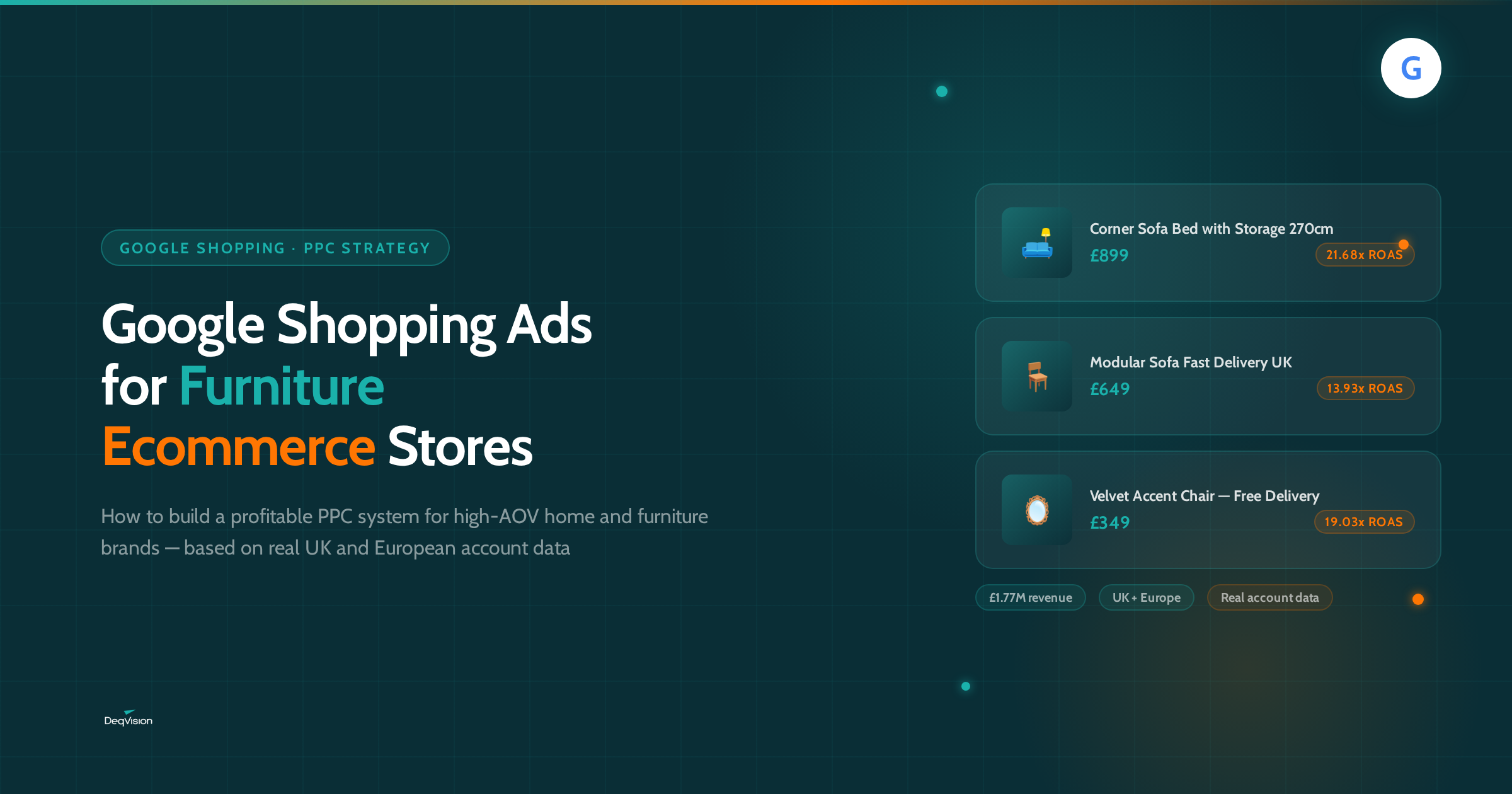
From our UK client data: a sofa brand generating over £1.77M in revenue from Google Ads over 6 months had an average order value of £860. Brand protection campaigns in that account returned 21.68x ROAS because buyers who had already researched were converting at near-zero acquisition cost.
2. Shopping Campaigns vs Performance Max: What the Data Shows
Campaign StrategyThe question every furniture store asks is whether to run standard Shopping campaigns, Performance Max, or both. The honest answer is that both have a role, but they behave very differently, and treating them as interchangeable is a common mistake.
| Feature | Standard Shopping | Performance Max |
|---|---|---|
| Control over placements | High | Low |
| Search term visibility | Full reporting | Limited |
| Best for brand protection | Yes | Not directly |
| Scale potential | Moderate | High |
| Creative assets required | None | Images, copy, videos |
| Ideal budget range | Any | £3,000/month+ |
From a European home decor client account, a standard Shopping campaign running all products returned 13.93x ROAS over 6 months. The PMax free delivery campaign in the same account returned 19.03x ROAS but required significantly more creative input and took longer to stabilise. Both campaigns served different roles in the funnel and neither replaced the other.
Our recommendation: Start with a well-structured Shopping campaign to establish baseline performance and gather search term data. Add Performance Max once you have at least 3 months of conversion history and a clear product feed. Running both simultaneously with proper audience exclusions is the most effective setup for furniture stores at £30K/month and above.
3. How to Structure a Google Ads Account for Furniture Ecommerce
Account ArchitectureAccount structure is where most furniture stores and many PPC agencies get things wrong. A single Shopping campaign covering all products with one budget and one bidding strategy cannot optimise properly. Furniture catalogues typically include products with very different margins, price points, and conversion rates. Mixing them into one campaign forces the algorithm to make tradeoffs it cannot resolve well.
A structured furniture account typically has four distinct campaign layers:
- Brand protection: a dedicated Search campaign bidding on your own brand name. This is non-negotiable once you are spending on other channels. In our UK client data, the brand protection campaign generated 336 conversions at 21.68x ROAS over 6 months at a fraction of the total spend. Buyers who already know your brand convert at near-zero marginal cost, and without this campaign, competitors can intercept them.
- Fast delivery or bestsellers: a separate PMax or Shopping campaign for products with shorter delivery times or highest conversion rates. Delivery speed is one of the top purchase decision factors for furniture buyers and it deserves its own campaign with its own budget signal.
- Full catalogue: a broader Shopping campaign covering the rest of the range. This drives discovery and captures long-tail queries across all product categories.
- Geographic segmentation: for stores serving multiple regions with different delivery costs or product availability, splitting campaigns by geography gives you better control over spend and ROAS by market.
In the European home store account, the Shopping campaign alone drove 399 conversions worth €127K over 6 months on €9,134 in spend. The key was segmenting by product category and excluding low-margin items from the primary campaign.
4. Your Product Feed Is Your Most Important Asset
Feed OptimisationMost furniture stores underestimate how much their product feed affects Google Shopping performance. Google uses the feed to match your products to search queries. If your titles are vague, your images are plain white backgrounds, and your descriptions are copied from the manufacturer, Google has no meaningful signal to work with and your campaigns will underperform regardless of how well the account is structured.
The highest-impact feed improvements for furniture stores are:
- Title structure: include material, colour, size, and key feature in the title. "Corner Sofa Bed with Storage 270cm Dark Grey Velvet" outperforms "Corner Sofa Bed" in every test we have run. Buyers search with specifics and Google matches titles to queries.
- Custom labels: use custom labels to segment products by delivery speed, margin tier, or category. This allows you to apply different bidding strategies to fast-delivery products versus made-to-order items without restructuring your whole feed.
- Lifestyle images: Google now supports lifestyle images in Shopping ads alongside the standard product image. For furniture, lifestyle images showing the product in a real room context consistently improve CTR compared to white background shots.
- Price accuracy: keep prices updated in real time. Outdated prices cause Google to disapprove products or reduce their visibility. Furniture stores running sales or seasonal pricing need feed refresh rates set to daily at minimum.
From experience: one of the first changes we made on a UK client account was rebuilding product titles to include material, dimensions, and delivery speed. CTR on Shopping ads improved within the first two weeks without any change to bids or budget.
5. Bidding Strategy and ROAS Targets for High-AOV Products
BiddingSetting the right ROAS target for a furniture Shopping campaign is not obvious, and getting it wrong in either direction causes problems. Set it too high and the algorithm cannot find enough conversions to learn. Set it too low and you overspend before the campaign has stabilised.
For furniture stores, the appropriate ROAS target depends heavily on average order value and margin. A store with a £200 AOV and a 40% margin needs a very different target ROAS than one with an £800 AOV and a 55% margin.
- For accounts at early stages with limited conversion history, start with Maximise Conversions and no target ROAS. Let the algorithm gather data for 4 to 6 weeks before adding a constraint.
- Once you have at least 30 conversions per month in a campaign, switch to Target ROAS. A starting target of 3x to 4x is reasonable for furniture accounts at £30K to £80K monthly revenue.
- Brand protection and remarketing campaigns can run at much higher ROAS targets (10x to 20x) because the audience quality is significantly higher and conversion costs are low.
- Performance Max campaigns typically require a lower initial ROAS target to scale. Setting it too aggressively early limits impressions and prevents the campaign from learning.
Across the UK furniture client account: overall ROAS across all campaigns was 3.92x on £452K in spend, generating £1.77M in revenue. The top-performing individual campaigns (brand protection and express delivery Shopping) operated at 7.66x to 21.68x ROAS, subsidised by the higher-spend prospecting campaigns running at 3x to 3.5x.
6. Delivery as a Google Ads Growth Lever
DifferentiationOne pattern that shows up clearly across both UK and European furniture accounts is the performance difference between campaigns that lead with delivery speed and those that do not. Furniture buyers are acutely aware of delivery times. A sofa that arrives in 3 to 5 days converts at a meaningfully higher rate than the same sofa with a 6 to 8 week lead time, and that difference is visible at the campaign level.
Dedicated campaigns for in-stock or fast-delivery products consistently outperform general catalogue campaigns in both click-through rate and conversion rate. In the UK client account, the fast delivery PMax campaign drove £537K in revenue over 6 months. In the European account, the free delivery PMax campaign ran at 19.03x ROAS compared to a 6.87x ROAS on the general primary campaign.
If you have a meaningful portion of your range available for fast delivery, that subset deserves its own campaign with its own budget, its own creative, and delivery time prominently featured in ad copy and product titles.
7. Google as Part of the Full Marketing System
VISIONARY MethodGoogle Shopping and Search are powerful in isolation but they are most effective as part of a complete acquisition and retention system. The VISIONARY Method used by DeqVision integrates Google Ads with Meta Ads, email marketing, CRM automation, and creative strategy so each channel reinforces the others rather than operating independently.
In practice, this means:
- Meta Ads drive awareness and product discovery for buyers who are not yet actively searching
- Google Search and Shopping capture the same buyers when they move into active research mode and start entering commercial queries
- Email flows and CRM sequences follow up with buyers who clicked but did not convert, covering the 14 to 30 day consideration window
- Brand protection campaigns intercept buyers who have already been warmed by Meta and are now Googling your store name directly
Running Google in isolation, without connected Meta campaigns and email follow-up, means you capture only the bottom portion of the buying journey and miss the buyers still in the research phase. For furniture stores with high AOV and long consideration windows, that gap in the funnel represents significant lost revenue.
Explore the full-stack approach for home ecommerce and furniture brands at deqvision.com/niche-home-related-ecommerce
FAQ: Google Shopping Ads for Furniture Stores
What ROAS should a furniture store expect from Google Shopping?
This depends on your AOV and margin structure. Furniture accounts managed by DeqVision have ranged from 3.92x overall ROAS on a high-spend UK account to 13.54x on a European account with a lower AOV and stronger brand. Brand protection campaigns within those accounts returned 21.68x and 65.25x respectively. A realistic starting expectation for a well-structured account is 3x to 5x blended ROAS, with specific campaigns performing significantly higher.
Should a furniture ecommerce store run Shopping campaigns or Performance Max?
Both, in most cases. Standard Shopping campaigns give you control, transparency, and clear search term data. Performance Max can scale volume but requires more creative input and conversion history to perform well. The recommended approach is to start with Shopping, build up conversion data, then add Performance Max once you have a stable baseline.
How important is brand protection for furniture brands on Google?
Extremely important, and often overlooked. Once you are spending on Meta or other awareness channels, competitors can bid on your brand name in Search and intercept buyers who are already familiar with you. A brand protection campaign costs very little and consistently returns the highest ROAS in any furniture account. It is one of the first campaigns we set up on any new account.
How long does it take to see results from Google Shopping for furniture?
Allow 6 to 8 weeks before drawing conclusions. Furniture has a 14 to 30 day purchase consideration window, which means early campaign data is incomplete. Campaigns that appear to be underperforming in week two often look very different by week six once delayed conversions are attributed correctly.
What makes a good furniture PPC agency?
An agency that understands the furniture buying cycle, structures accounts around product categories and delivery tiers, and integrates Google Ads with the rest of your marketing system. Generalist PPC agencies typically apply ecommerce frameworks built around impulse-purchase products, which do not work for high-AOV furniture with long consideration windows.
How much should a furniture store spend on Google Ads?
For stores generating £30K to £80K monthly revenue, a starting Google Ads budget of £3,000 to £8,000 per month is a reasonable range. The right number depends on your margins, product range, and whether Google is the primary acquisition channel or supporting Meta. Stores at higher revenue levels typically allocate between 8% and 15% of revenue to paid search.
Running Google Ads for your furniture store and not seeing the results you expect?
We work with home ecommerce and furniture brands across the UK to build structured Google Ads systems that generate consistent returns. Book a free discovery call and we will look at your current setup and show you exactly what we would change.
Book a Free Discovery Call