
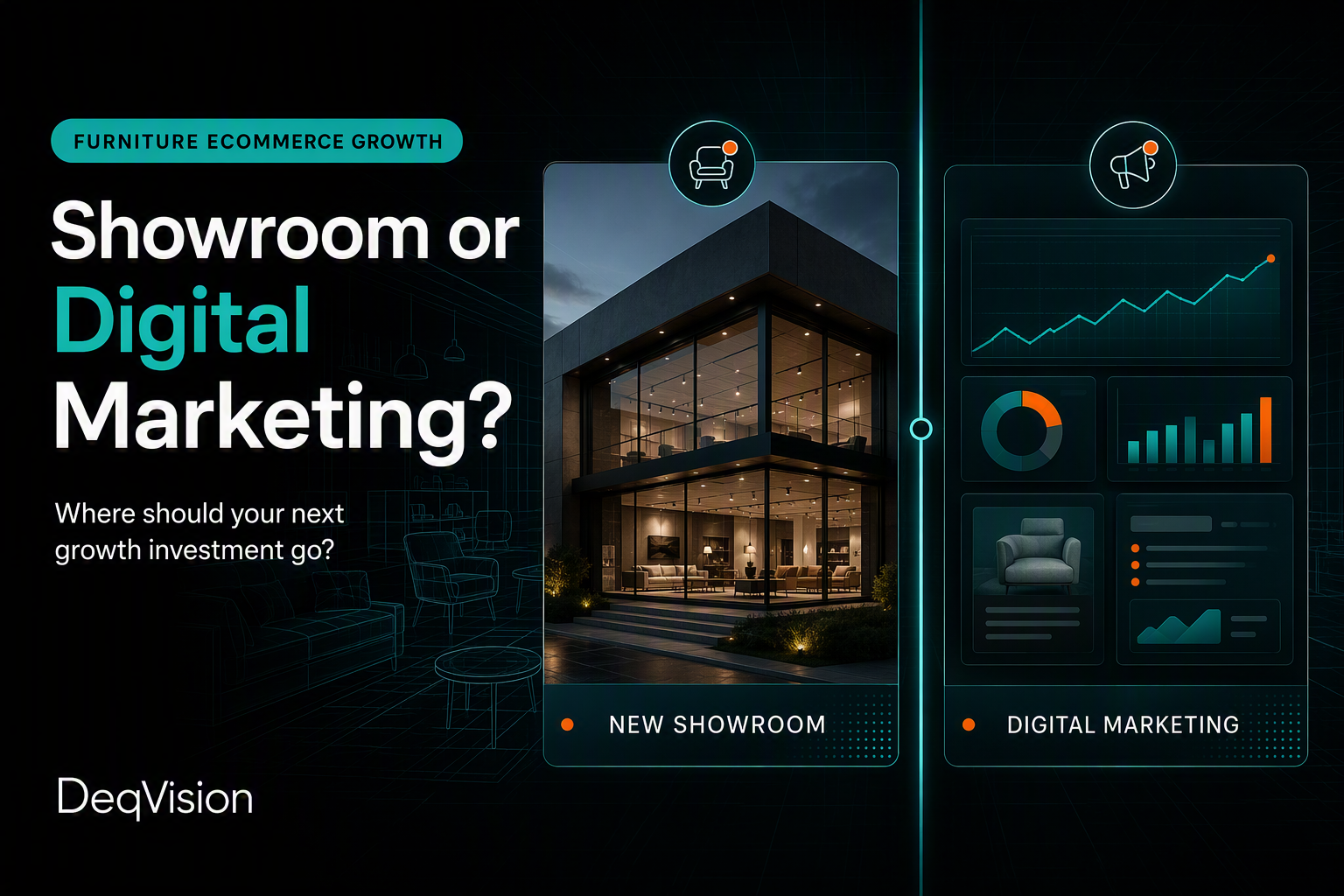
A new showroom can be a strong growth move. So can digital marketing. But they solve different problems. The wrong choice ties up cash, slows momentum and leaves the real constraint untouched.
The short answer: invest in the thing that is holding growth back. If demand is already stronger than your current showroom can handle, another location may be right. If the brand is not reaching enough of the right people, cannot be remembered, or does not have a repeatable way to turn attention into sales, digital marketing should come first.
The decision is not offline versus online. It is where your next pound creates the most profitable demand.
Start with the real question: what is limiting growth?
Furniture founders often frame this as a choice between a physical asset and a marketing expense. That is too simple. A showroom is a distribution decision. Digital marketing is a demand and brand decision.
Before committing to either, identify the constraint. Is your best current showroom consistently busy, converting well and turning away demand from another area? Or do you have great products and a capable website, but too few of the right buyers know you exist?
| If this is true | Your real constraint | Likely next move |
|---|---|---|
| Current showroom is profitable and local demand is proven | Physical access or regional reach | Model another showroom carefully |
| Website converts but traffic and branded search are flat | Not enough awareness or demand | Invest in brand-led digital marketing |
| Traffic is high but conversion is weak | Website, offer, product pages or trust | Fix conversion before scaling either |
| Ads only work when discounted heavily | Weak brand preference and thin margin | Build brand and creative before adding spend |
When another showroom makes sense
A showroom is not old-fashioned. For furniture, it can remove a major buying barrier. People want to sit on the sofa, feel the fabric, compare finishes and see scale in real life. A good showroom also gives your online marketing stronger proof because buyers can visit, film content there and trust the brand more.
But a new location carries rent, fit-out, staff, stock, utilities and management time. It should be a response to proven demand, not a substitute for a weak customer acquisition system.
- Your existing showroom is profitable. You know its real contribution after rent, staff, discounting and delivery costs.
- You can prove local demand. You have postcode data, delivery data, website sessions and customer enquiries that show an underserved area.
- The sales process can be repeated. Your team knows how to sell, follow up and turn visits into orders without relying on one founder.
- Operations can absorb it. More orders will not break stock, delivery, customer service or installation.
When digital marketing should come first
For many furniture brands on the route to £1M per month, the bigger opportunity is not another building. It is being seen, remembered and chosen by more of the right buyers.
Digital marketing gives you a faster way to test markets, build demand beyond a single postcode and learn which products, messages and audiences create profitable growth. But only when it is built as a system.
Digital marketing is not making 50 random ads and hoping one works. If the brand looks different in every campaign, sounds like every competitor and gives buyers no reason to remember it, more creative volume will not solve the problem.
A furniture buyer may see your Instagram video, visit twice, search your brand on Google, compare product details, ask a partner, then buy two weeks later. Your marketing needs to make sense across that whole journey.
You cannot scale ads without a memorable brand
At low spend, you can sometimes buy a sale with a sharp offer and a good product image. At higher spend, that gets harder. Your audience sees more ads, compares more brands and forgets most of them.
A memorable furniture brand does not need to be loud. It needs to be consistent. The product, photography, point of view, customer proof and language should make the same promise again and again. That is what helps paid traffic convert now and makes future clicks less expensive.
Choose a clear position
Be specific about who the furniture is for, what it solves in their home and why they should choose you over a similar-looking brand.
Build a repeatable creative system
Use a small number of strong angles: real homes, material quality, design details, customer stories and practical objections. Make each one recognisable as yours.
Connect paid media, search and email
Meta creates attention. Google captures intent. Email brings people back. The message should be consistent across all three, not reinvented channel by channel.
Measure brand demand as you scale
Watch direct traffic, branded search, returning visitors, email sign-ups and conversion rate alongside ROAS. These show whether the brand is becoming easier to choose.
A simple way to compare the two investments
Put both options through the same commercial test. Do not compare a showroom’s revenue potential with an ad platform’s reported ROAS. Compare expected contribution, speed to learning and risk.
| Question | New showroom | Digital marketing system |
|---|---|---|
| How quickly can you test it? | Slow. Lease, fit-out and hiring come first. | Fast. Test markets, products and messages in weeks. |
| How easy is it to change course? | Hard. Fixed costs and location commitment. | Easier. Budgets, audiences and creative can be adjusted. |
| What does it need to work? | Proven local demand and strong operations. | Clear brand, strong website, good creative and measurement. |
| What does it unlock? | Physical trust and local selling capacity. | Reach, demand creation and scalable customer acquisition. |
The strongest answer is often both, in the right order
This is rarely a permanent choice. The best furniture brands use digital marketing to create demand in the places where they may later open showrooms. Then they use the showroom to improve conversion, content and trust in those markets.
Start with a strong digital foundation. Build a brand people can recognise. Prove that you can acquire customers profitably outside your immediate area. When the data shows concentrated demand and your operation is ready, a showroom becomes a better bet.
The practical rule: do not open a showroom to compensate for weak brand demand. Do not scale ads to compensate for a poor website or unclear offer. Fix the constraint first, then invest behind what is already working.
Frequently asked questions
Should a furniture brand open another showroom or invest in digital marketing?
Choose based on the growth constraint. Another showroom makes sense when location demand and existing store economics are proven. Digital marketing is usually the better next move when the brand needs more reach, demand and a repeatable way to acquire customers.
Can digital marketing replace a furniture showroom?
Not completely. Showrooms help customers experience products. Digital marketing helps more people discover the brand, trust it and visit either the store or the website. The strongest businesses use both together.
Why is brand awareness important before increasing ad spend?
Furniture buyers often take days or weeks to decide. If they cannot remember your brand after seeing an ad, more spend only creates more forgettable traffic. Clear and consistent brand work makes future ads more effective.
What should I measure before opening another furniture showroom?
Measure current showroom profit, local demand, online conversion rate, cost to acquire a customer, delivery capacity, sales process and the total monthly sales required to cover fixed costs.
Not sure where your next growth investment should go?
We help furniture brands find the real constraint, build a memorable digital presence and turn paid media into a system that supports profitable scale.
Book a growth call