
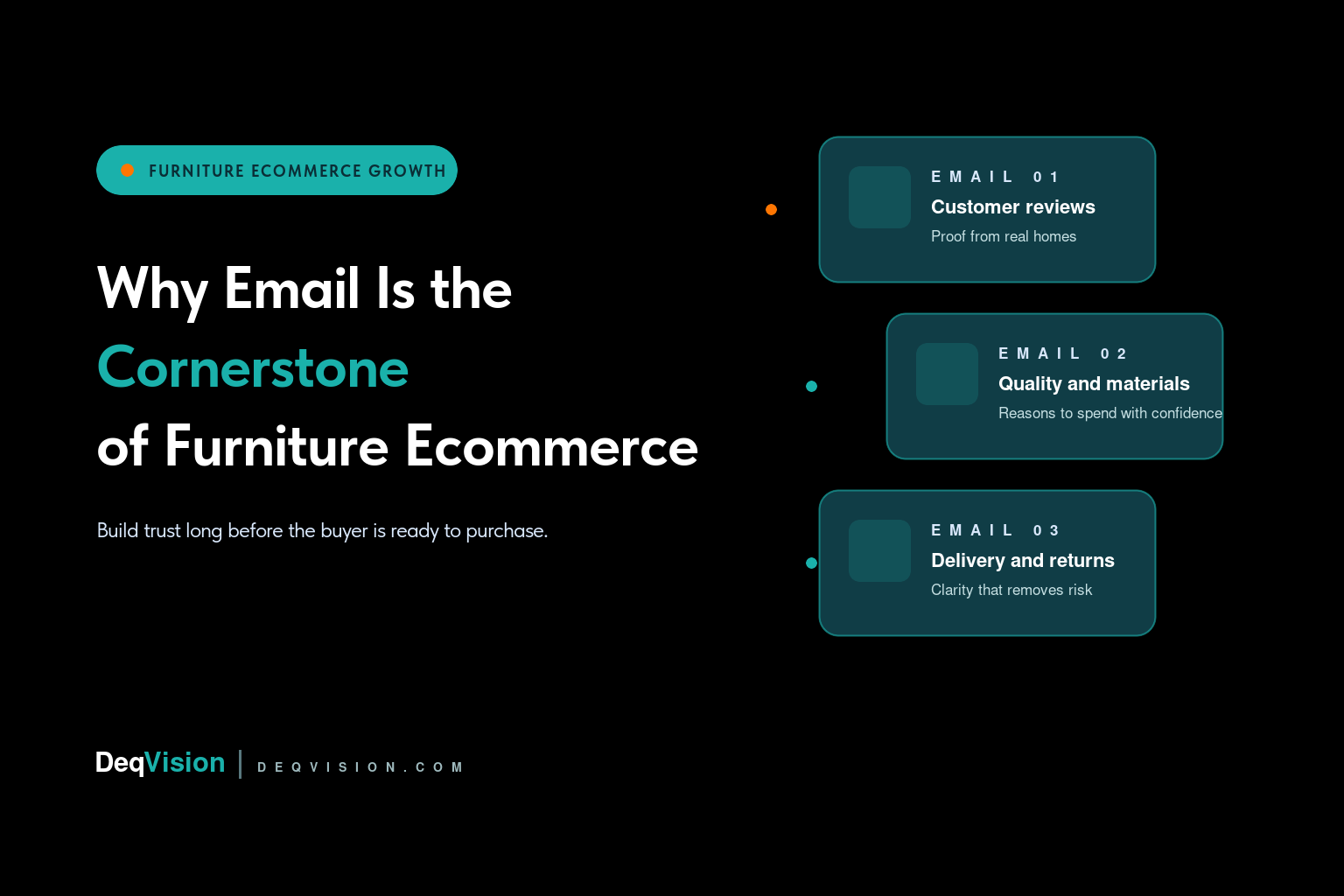
For a £40 side table, a single good ad may be enough. For a £1,400 sofa, most people need more time, more proof and more reasons to trust you. Email is where that confidence is built after the first click.
Short answer: Email marketing is central to furniture ecommerce because it gives potential buyers repeated, useful contact with your brand while they decide. It lets you show the quality, delivery support, reviews, materials and service that make a higher-value online purchase feel safe.
Furniture buyers do not usually buy on the first visit
Furniture is a considered purchase. A customer may see your Meta ad, browse two product pages, compare you with three other brands and then leave. They may come back a week later after measuring their room or speaking to their partner.
If the only message they receive is another paid ad, you are relying on the platform to win the sale again and again. Email gives you a direct way to stay useful during that decision without paying for every touch point.
It keeps your brand present
A well-timed email keeps you in the buyer's mind between visits. That matters when they are comparing a product for days or weeks, not minutes.
It answers the questions ads cannot
Ads create interest. Email can explain materials, comfort, dimensions, delivery, guarantees and returns in the detail a serious buyer needs.
It protects your margin
Once a customer is on your list, you can bring them back without buying another click. That is vital when paid traffic becomes more expensive as you scale.
Trust is the real conversion lever for furniture online stores
People are careful when buying furniture online. They cannot sit on the sofa, inspect the finish or check the colour in their room before they pay. Your marketing has to close that trust gap.
Email works because it gives you space to make the purchase feel less risky. It is not about sending more promotions. It is about putting the right proof in front of the right person at the moment they need it.
| Buyer concern | What email should show | Why it helps |
|---|---|---|
| “Will it look right in my home?” | Customer photos, room sets, videos and styling examples. | Helps them picture the product in a real space. |
| “Is this brand reliable?” | Reviews, founder story, customer service standards and delivery updates. | Shows there are real people behind the store. |
| “Is the quality worth the price?” | Materials, construction details, care advice and close-up product content. | Gives the buyer a logical reason to spend more. |
| “What if something goes wrong?” | Clear returns, warranties, delivery process and support contact details. | Reduces the fear of buying a large item online. |
Your USP should not live only on the product page
Most furniture brands have real strengths: made-to-order options, better materials, faster delivery, a longer warranty, local manufacturing or specialist design knowledge. The problem is that buyers often see those points once and then forget them.
Email gives you the chance to repeat your strongest reasons to buy in different formats. One email can focus on craftsmanship. Another can show reviews from customers with the same hesitation. Another can explain how delivery works. The message stays consistent, but the proof changes.
- Use your welcome series to introduce the brand and explain what makes it different.
- Use browse-abandon emails to bring back people with the exact product proof they need.
- Use abandoned-cart emails to deal with price, delivery and return objections.
- Use post-purchase emails to build confidence, reduce buyer's remorse and create repeat demand.
Important: more emails do not automatically create more revenue. A furniture brand that sends the same discount every week trains people to wait. The better approach is a steady mix of product proof, useful advice, customer stories and clear offers when they genuinely make sense.
Why “lots of different ads” is not a digital marketing strategy
Creative volume matters, but it is only one part of the system. If every ad introduces a different message and your email says something else again, buyers cannot remember what your brand stands for.
To scale toward £1M per month, your brand needs to become easy to recall. That comes from consistency. The same product strengths, visual world, customer proof and promise should appear in your Meta ads, Google results, product pages and email flows.
Email is where that consistency becomes deeper. It turns a quick impression from an ad into a relationship that has enough proof behind it to earn a bigger purchase.
The core email flows every furniture brand should have
Before you send regular campaigns, make sure the automated basics are working. These flows are always on, so they keep recovering sales and building trust while your team works on growth.
Welcome flow
Introduce the brand, your key USPs, bestsellers and reviews. Give new subscribers a strong reason to remember you.
Browse-abandon flow
Send useful proof around the category or product viewed. Do not just say “you forgot something”. Help the person decide.
Abandoned-cart flow
Address delivery, quality, returns and customer service before reaching for a discount. For furniture, reassurance often wins the sale.
Post-purchase flow
Confirm the buyer made the right choice, set clear delivery expectations and ask for reviews or user-generated content at the right time.
How to judge whether email is doing its job
Do not judge email only by last-click revenue. A buyer may read an email, search your brand two days later and then buy through Google. That does not mean the email did nothing.
Look at the full picture: returning customer rate, repeat site visits from subscribers, assisted revenue, list growth, revenue per recipient and the share of revenue that comes from email over time. You could use a tool like Triple Whale to help you with this.
Frequently asked questions
Is email marketing worth it for furniture stores?
Yes. Furniture buyers often need several touch points before they purchase. Email gives a store a direct way to build trust, repeat its strongest selling points and recover interest without paying for every visit.
What emails should a furniture ecommerce store send first?
Start with a welcome flow, browse-abandon flow, abandoned-cart flow and post-purchase flow. These cover the main moments where people need more information or reassurance before and after buying.
Should furniture brands offer discounts in every email?
No. Constant discounts reduce margin and can teach people to wait. Use email first to show quality, reviews, delivery support, styling ideas and other proof that helps a buyer choose with confidence.
How does email marketing support paid ads for furniture brands?
Paid ads create attention and bring people to the website. Email helps keep those people engaged after the first visit, builds trust during a longer buying cycle and lowers the need to buy every return visit through paid media.
Build a system buyers remember
DeqVision helps furniture brands connect paid media, creative, email and CRM into one clear growth system. If your store is already doing £100K+ per month and aiming for £1M, we can show you where the biggest gaps are.
Book a free growth call